

You’ve paid for a 1Gbps Cable internet plan, but every evening your streaming buffers, video calls glitch, and downloads crawl to a halt. You’ve upgraded your router, swapped Ethernet cables, and even called your provider—yet the problem persists. What if the bottleneck is a tiny, overlooked cable you’ve never thought to replace? As someone with a background in telecommunications engineering and signal processing, I’ve uncovered the hidden culprit: low-quality or aging coaxial cables between your wall outlet and modem. These cables leak signals, invite interference, and strangle your internet speed—while a simple upgrade to a high-quality coaxial cable can unlock your plan’s full potential. Let’s break down the science, data, and step-by-step fix.
To understand why coaxial cables matter, we first need to grasp how Cable internet works. Your provider sends data signals through coaxial cables to your modem, which converts them into Wi-Fi or Ethernet for your devices. These signals operate at high frequencies, and their integrity depends entirely on the cable’s ability to contain and transmit them. Low-quality or aging cables fail at this basic task: their thin shielding lets signals “leak” out, while also letting external interference seep in. The result? Your modem receives a weak, noisy signal, and it throttles speed to maintain stability.
The difference between a low-quality and high-quality coaxial cable is stark, measured in key performance metrics. The gold standard for Cable internet is RG-6 cable, which features a thick copper core, double shielding, and a characteristic impedance of 75Ω—perfect for high-frequency data. In contrast, older RG-59 cables have a thinner core and single shielding, leading to 2x more signal attenuation at 1GHz (12dB per 100ft vs. 7dB for RG-6) 。 Signal leakage is another critical factor: RG-6’s double shielding achieves over 85dB of shielding attenuation at 1GHz, while RG-59 or damaged cables can leak up to 30dB of signal—enough to cut your speed by 40-60% 。 Even small cracks in the cable’s PVC jacket or loose F-type connectors can cause significant leakage, turning a 1Gbps plan into a 300Mbps disappointment.
The physical design of coaxial cables directly impacts performance. High-quality RG-6 cables have a rigid yet flexible structure, with a foam polyethylene dielectric that minimizes signal loss and a durable low-smoke, halogen-free sheath that resists wear and moisture. Their F-type connectors are precision-machined, with a threaded design that creates a tight seal to prevent signal leakage. In contrast, cheap cables use thin, brittle shielding, plastic dielectrics, and poorly crimped connectors that loosen over time. They’re also lighter and flimsier, making them prone to bending damage that disrupts the signal path. A well-built RG-6 cable feels substantial in your hand, with a smooth jacket and secure connectors that don’t wiggle.
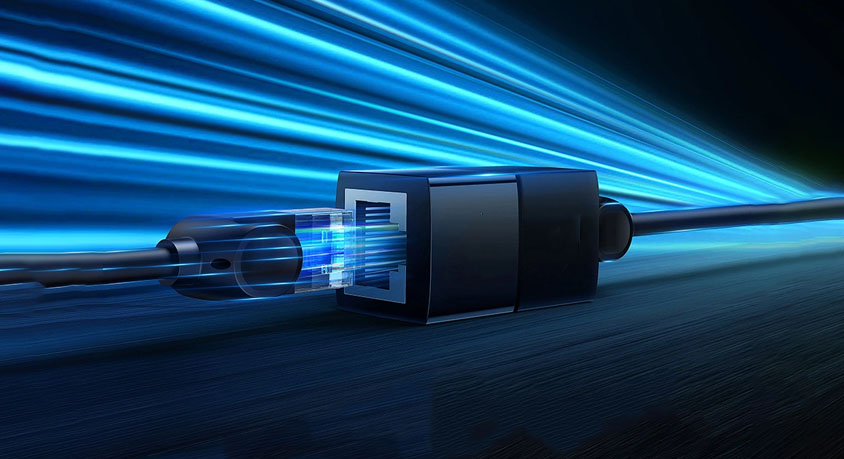
Real-world scenarios highlight the transformative impact of a cable upgrade. A remote worker in a 20-year-old home struggled with 200Mbps speeds on a 500Mbps plan—until they replaced their aging RG-59 cable with RG-6. Overnight, their speed jumped to 480Mbps, and video calls became glitch-free. A family streaming 4K movies endured constant buffering, only to discover their coaxial cable had a cracked jacket near the wall outlet. Replacing it with a shielded RG-6 eliminated interference from their smart TV, letting them stream without interruption. These stories aren’t anomalies—industry tests show that upgrading from RG-59 to RG-6 can boost speeds by 30-100% for Cable internet users, depending on the original cable’s condition.
Checking your current coaxial cable is simple, even for non-technical users. First, visually inspect the cable from wall outlet to modem: look for cracks, fraying, or kinks (sharp bends damage the shielding). Next, check the F-type connectors—if they’re loose, corroded, or feel wobbly, they’re causing signal leakage. You can also use your modem’s diagnostic page to check the signal-to-noise ratio (SNR): for modern QAM256 signals, a SNR above 30dB is ideal, while below 23.5dB indicates severe interference or leakage. If your SNR is low, a cable upgrade is likely the fix.
Replacing the cable is a straightforward DIY task that takes 10-15 minutes. First, purchase a high-quality RG-6 cable (6-10 feet is ideal—longer cables increase attenuation) and F-type compression connectors. Use a coaxial cable cutter to trim the old cable cleanly, then strip the jacket to expose the copper core, dielectric, and shielding. Slide the compression connector onto the cable, crimp it with a multi-function tool to ensure a tight, waterproof seal, and connect one end to the wall outlet and the other to your modem. Avoid twisting or bending the cable sharply—maintain a gentle curve to preserve the shielding. For outdoor or damp areas, use weatherproof connectors to prevent moisture damage.
Like any solution, coaxial cable upgrades have tradeoffs. Their primary advantage is cost-effectiveness—high-quality RG-6 cables cost $10-20, a fraction of router upgrades or plan boosts. They’re also easy to install, requiring no professional help. However, they won’t fix provider outages or network congestion, and in rare cases, hidden wiring (inside walls or ceilings) may be difficult to replace. This upgrade is ideal for Cable internet users who aren’t getting their subscribed speeds, experience frequent buffering, or have older homes with RG-59 cables. It’s less necessary for users with new homes (built after 2010) that already have RG-6 wiring, though checking connectors is still worthwhile.
Practical guidance for maximizing results: First, choose RG-6 with double shielding for maximum interference protection. Second, keep the cable length under 10 feet—longer cables increase signal loss. Third, use compression connectors instead of twist-on types—they create a 360-degree seal that prevents leakage and moisture intrusion. Fourth, avoid running the cable near power lines or electronics to reduce interference. Fifth, after installation, recheck your modem’s SNR—you should see an improvement of 5-10dB, translating to faster speeds.
In summary, the coaxial cable between your wall and modem is the unsung hero of Cable internet performance. Low-quality or aging cables leak signals and invite interference, turning fast plans into slow, unreliable connections. Upgrading to a high-quality RG-6 cable—with double shielding, precision connectors, and minimal attenuation—unlocks your plan’s full speed potential. This simple, low-cost fix is often overlooked, but it’s one of the most effective ways to boost internet performance. Whether you’re working from home, streaming 4K content, or gaming online, a better coaxial cable ensures you get the speed and stability you’re paying for.
Disclaimer: Mention of any brand or trademark is for identification purposes only and does not indicate any partnership or endorsement.
